The Whole Horn
Freedom of expression is downstream of freedom of movement. Why all twelve keys, in any style — and what happens on the day a student stops fighting the instrument.
There is a moment I have watched happen to students for thirty years, and everything in this app exists to bring it closer.
It arrives when a player can move freely. Not quickly — freely. High and low, fast and slow, loud and soft, in any of the twelve keys, without the instrument arguing back. Until then, every musical thought has to be negotiated with the horn: can I get there, is that fingering safe, will the note speak. After it, the negotiation simply stops.
What is left is the player.
I want to be exact about what that moment is not. It is not mastery of music theory. It is not having transcribed a thousand Coltrane solos — that is a wonderful thing to have done, and it is a different thing from this. A musician can walk onto a stage having done neither and start playing, because in that moment they are not reaching for what they know. They are reaching for what they feel, and the instrument is no longer standing between the two.
Jazz is often held up as the metaphor for freedom of expression, and I think that is right as far as it goes. But it stops one step short. Freedom of expression is downstream of freedom of movement. You cannot express what you cannot execute, and a player still fighting the horn is not choosing what to say — they are saying whatever the instrument will permit. Movement first. Expression follows, and it follows reliably.
Which is why none of this is really about jazz, or about any style at all. A classical player who can move freely is free in precisely the same way, and so is a player whose tradition has nothing to do with either. The style is what you do with the freedom. The freedom itself is the same thing for everybody, and it is built the same way.
Then something better happens, and it is the part I care about most. Once you are not fighting the horn, you have attention left over for everyone else on the stage. You can hear what is being played, understand it, react to it, answer it. You are in the conversation. It matters surprisingly little whether you share a style with the other players, or even a tradition — music is being spoken, and you can hear it and reply. That is not a figure of speech. I have watched it happen between musicians who had no spoken language in common at all.
People call that a flow state, and there is nothing mystical about it. It is what is left over when the mechanical obstacles are gone.
Now the unglamorous part, because I am a teacher and I would rather be honest about the work.
The way there is the twelve scales, one at a time, straight up and down, in every key. I start everyone on F major, one octave — low F is the instrument's reference sound, and I want a student to hear the horn before they read the page. Roughly two hours of honest attention per key, twelve keys. I tell my students to think of it as about twenty-four hours of work, spread over however many weeks their life allows. That is a rule of thumb from my own studio and not a promise; some students take considerably longer. But it is not a decade — and I think the size of it deserves to be said out loud, because most beginners privately assume the answer is a decade, and give up before they have started.
What surprises people is how early the change begins. Long before the twelve keys are finished, a student starts describing themselves differently. They stop saying they are learning an instrument and start saying they play one.
And when they finally stand on a stage and feel that freedom for the first time — the first time the horn does exactly what they meant, in front of other people, in real time — it is, for a great many of them, one of the most cathartic moments of their lives.
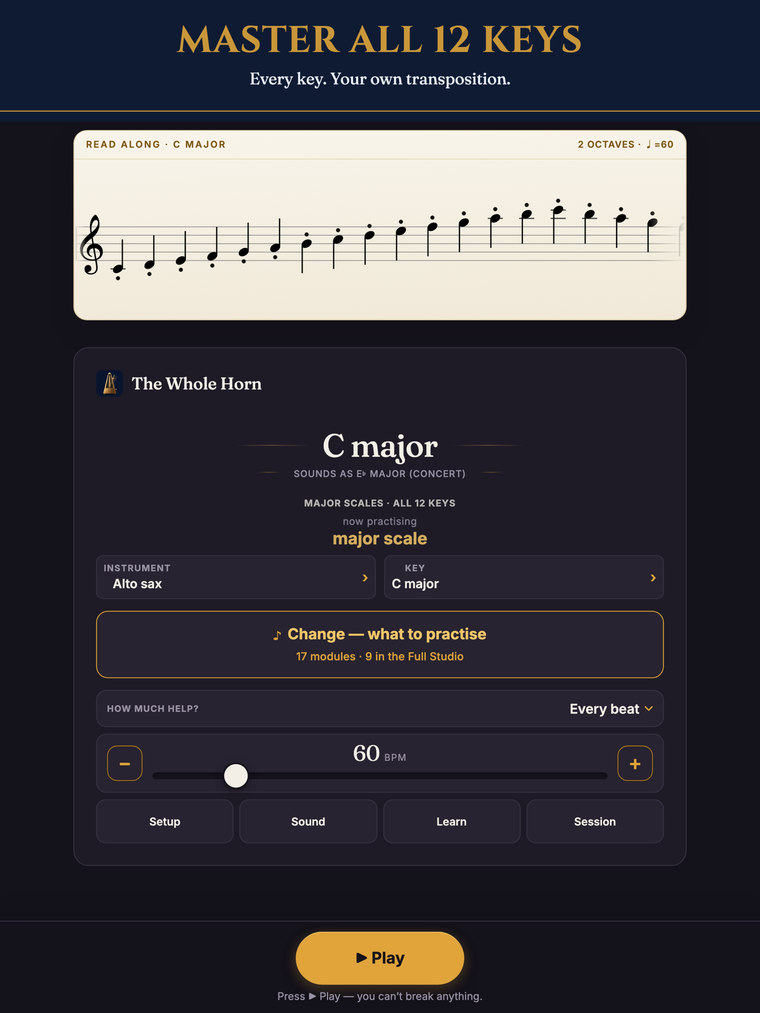
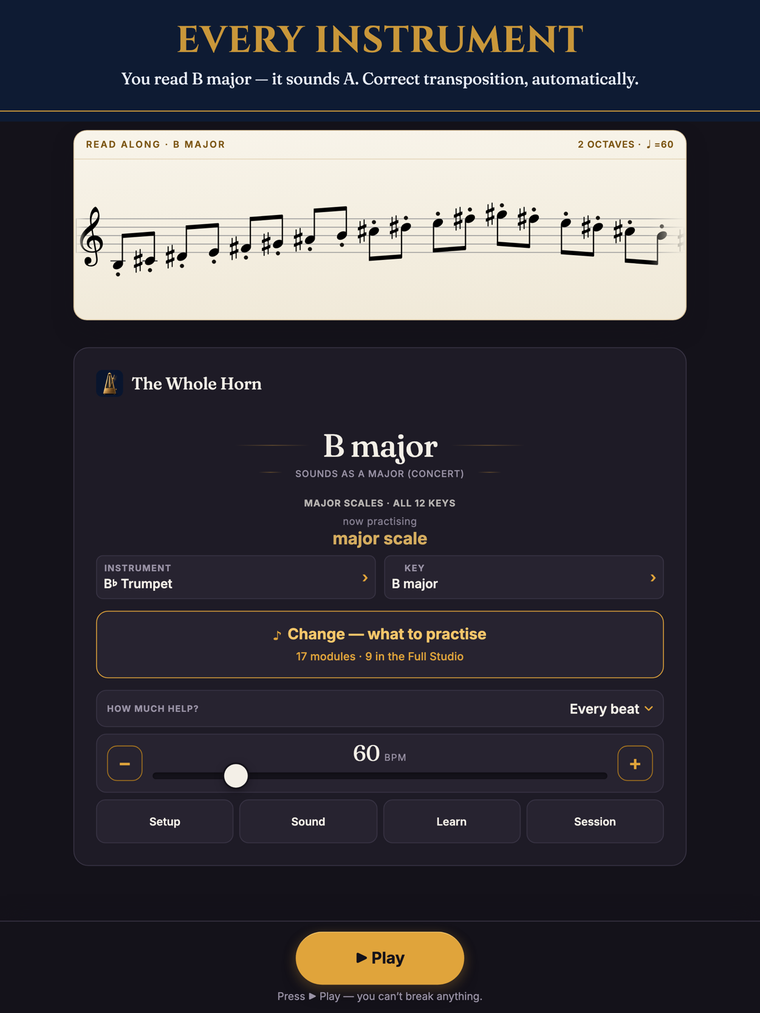
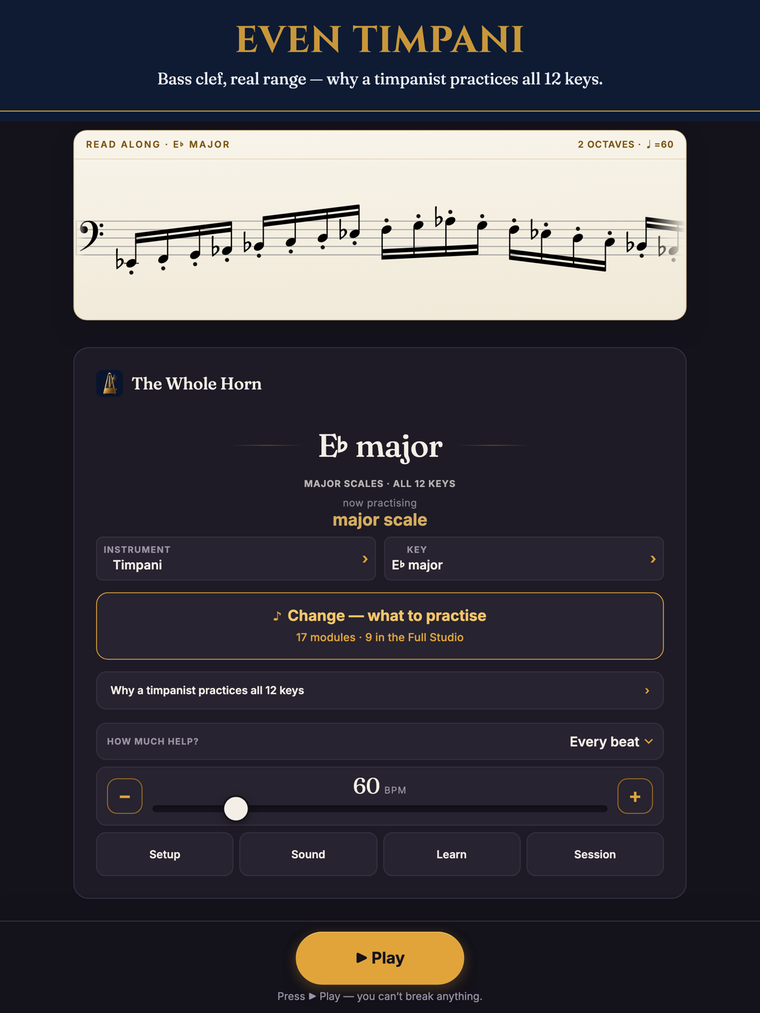
That is what this is for. Everything else in the app — the sixty-nine instruments, each in its own correct written key, the range slider that starts at three notes, the drones, the practice links — exists only to clear away whatever is standing between a student and that moment.
I have come to think this is not only about music, though I will keep the claim modest, being a saxophone teacher and not a philosopher.
Everything happens in the middle. On a bandstand the music is not made by whoever plays loudest; it is made in the space between the players, by whoever is listening hard enough to put something useful there. I have found the same to be true of most rooms — in a marriage, in a faculty meeting, in a country that has had rather more than its share of arguments. The people who hold things together are the ones who can hear what is actually being said and answer it, instead of waiting for their turn to speak.
A musician who is fluent, and who chooses to stand in the middle, becomes that person. Not the star — the glue. The one who connects a player on one side of the stage to a player on the other, and both of them to the room.
And then there is the room itself. For the length of a performance an audience attends to one thing together. Whatever divides the people sitting in it — and in the city where I teach that list can be long — none of it is operating for those minutes. Everyone is listening to the same thing at the same time, which is about as near to our common humanity as we get in public.
There is a phrase for what a bandstand does, and it comes from outside music entirely: parity of esteem. It means two parties being held in equal regard rather than one ranked beneath the other. It was coined for schools and is used now mostly in health policy, and I have never seen it practised anywhere as completely as on a stage.
You step onto a bandstand with a clean slate. Nobody there is required to care where you trained, what you have recorded, how old you are, which tradition you came up in, or what you did last year. Everyone is granted the same standing on arrival. From that moment the only currency is what you can offer to the music while it is happening — whether you made it better. It is the great equaliser, and I know of no other room in the human condition that works quite this way. It is most of the reason I have spent my life in them.
What that room runs on is empathy, and I mean the word plainly rather than sentimentally. I have come to think empathy is the highest form of intelligence, because on a stage every other faculty depends on it. Without empathy you cannot hear what someone else is doing. If you cannot hear, you cannot react. If you cannot react, you cannot communicate. And if you cannot communicate, you are producing sound but you are not yet playing music.
That is an immodest claim for an app about scales, and I know it. But the twelve keys are where it begins, and the reason I have spent thirty years starting people on F major is that I have seen where it can end.
Tom HornigSaxophone professor · Henri Selmer Paris Artist · Beirut


Every claim, explained in full · The letter to directors and teachers
Because freedom of expression is downstream of freedom of movement. A player who owns all twelve keys stops spending attention on which note comes next and can spend it on the music instead. The keys you skip become the keys you avoid.
Yes — in any style. A jazz chart, a pop horn line and an orchestral part all eventually go somewhere the player has not been. Twelve keys is what removes the flinch, whatever the repertoire.
Longer than a term and shorter than most players fear — the app assigns one scale per week, which is the pace this page argues for. The change is not that the scales become fast; it is that the instrument stops fighting back.
